The Beeline

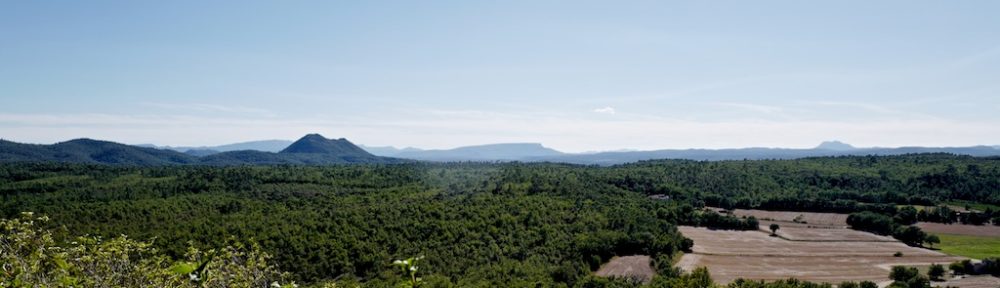
Imagine how attractive these flowers would look if you were a bee. According to the invaluable Plantnet app, it’s Verbascum chaixii ViLL. Which is ‘Nettle leaved Mullein’ to the rest of us.
Quote of the Day
”The only function of economic forecasting is to make astrology look respectable.”
- John Kenneth Galbraith
Musical alternative to the morning’s radio news
J.S. Bach | Jesu, Joy of Man’s Desiring | Leo Kottke
I once heard him play this live at the Cambridge Folk Festival sometime in the 1970s. And at one magical moment, the man sitting next to me began to whistle the chorale. And Kottke grinned in response.
Long Read of the Day
Greatness and the Machine
An interesting essay by Brendan McCord, based on a lecture he delivered at the 2026 Cosmos Feast at the Château de Tocqueville in Normandy. In it he argues that AI poses an unprecedented threat to human freedom and independent thought in a way that Tocqueville feared. There were, he thought, two inter-related dangers to democracies. One was ’soft despotism’, where government gradually assumes responsibility for daily life. The other was tyranny of the majority and a culture of conformity that discourages independent thinking. McCord argues that the long term danger of AI is that it might merge these two.
We face a condition no people has faced before: a tool that acts not on the world but on the will itself. Such a tool endangers things that a tyrant never could.
The first thing it risks is autonomy: the cultivated capacity to author your own reasoning. This means framing the question, weighing what matters, and then owning your judgment. This is not the same thing as agency. Agency is about getting things done. Like Elena, you can simultaneously be highly agentic, but devoid of all autonomy.
The second loss is older and grander. Tocqueville feared that equality would cost us the potential for greatness. He arrived in America, half-afraid that the democratic age had extinguished thumos – what the Greeks called the part of the soul that loves honor, contest, and daring.
Tocqueville, however, found it on the merchant ship. At the end of volume I in Democracy in America, he tries to solve the mystery of how American merchants were able to offer cheaper rates and dominate transatlantic shipping. He finds the answer in temperament.
The American leaves Boston to buy tea in China, is gone two years and touches land once, lives off brackish water and salt meat, runs into the storm under full sail and mends the ship as he goes. He does all this to sell a pound of tea for a penny less than the Englishman. He does this because, as Tocqueville writes, the Americans put a kind of heroism in their manner of trading. The old fire does not die in a democratic age, it changes address…
I’m not sure I buy the argument about the nature of the damage that AI could do. But I like people who think about this stuff outside the confines of the “AI Fight Club”. And in case you’re wondering what it costs to stay at the chateau, forget it. If you want to know the price, you can’t afford it.
Books, etc.
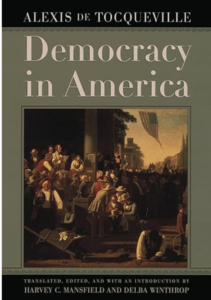
While we’re on the subject of Tocqueville, I’ve been entranced by the Economist’s Tocqueville Road Trip: Democracy in America at 250 which has made me feel ashamed that I’ve never read Tocqueville’s masterpiece. So I’ve asked for it as a birthday present.
What links AI and JMW Turner? Let me paint a picture for you…
My most recent Observer column:
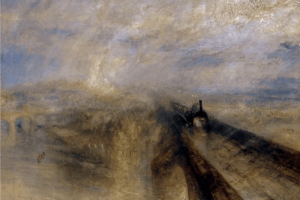
I’m staring at JMW Turner’s Rain, Steam, and Speed – The Great Western Railway, a painting he did in 1844 of a section of the line at the Maidenhead railway bridge. It’s a classic Turner landscape obscured by swirling clouds, wisps of steam and rain. Nothing is clear except the funnel of an oncoming steam train and the walls of the viaduct, built by Isambard Kingdom Brunel, which Turner has exaggeratedly foreshortened, leading our eyes to follow it back to the fuzzy horizon. Everything else in the picture is a misty haze.
Pondering the picture, I began to wonder if what I was looking at was a visual metaphor for our current plight. We’re in the middle of a traumatic phase transition – from a disintegrating socioeconomic order into a future that is unknowable and could conceivably be dystopian. Lots of things that we once regarded as unthinkable are happening on a daily basis. Assumptions that we used to regard as solid bases on which to plan for the future are evaporating like melting snow.
Take, for example, the belief that children would have better lives than their parents had. Or that a university degree was a ticket to employment. Or that young people who worked hard would be able to own a place of their own. Or that democratic politicians who took bribes and kickbacks would be shamed into resignation once their transgressions were exposed.
In the middle of this chaos, however, one certainty seems to have gripped our ruling elites: that AI is the future. It’s the modern counterpart for the steam locomotive in Turner’s picture. And – according to the dominant narrative everywhere – it’s coming for us all…
pdf download here
This Blog is also available as an email three days a week. If you think that might suit you better, why not subscribe? One email on Mondays, Wednesdays and Fridays delivered to your inbox at 5am UK time. It’s free, and you can always unsubscribe if you conclude your inbox is full enough already!