
Smoke signals
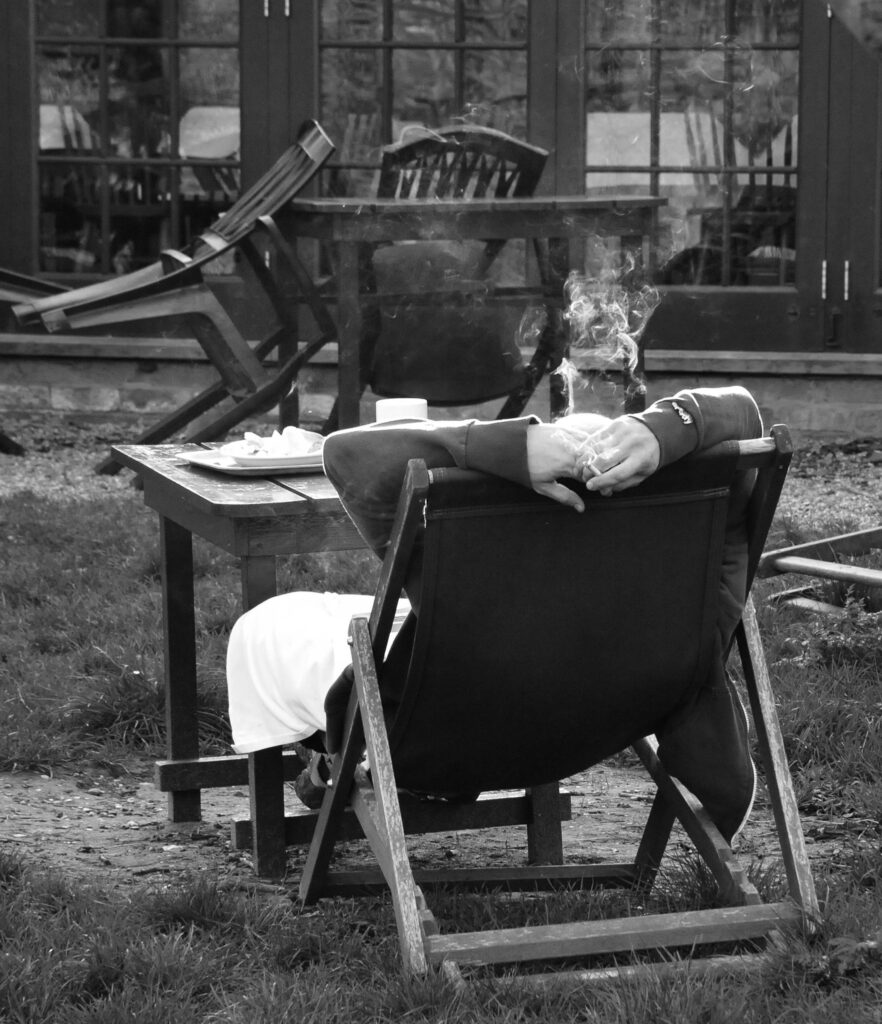
A relaxed smoker at The Orchard tearoom in Grantchester.
Quote of the Day
”Photography is note-taking on potentially everything in the world from every possible angle.”
-
Susan Sontag
Which is what my iPhone has been doing for years.
Musical alternative to the morning’s radio news
Steeleye Span | All Around My Hat (Live)
Long Read of the Day
How Not To Do Regime Change
Francis Fukuyama on the idiocy of the Iran war.
Or how American regimes never learn from history.
What is particularly maddening about this is that anyone who has lived through the last quarter century of U.S. Middle East policy should have understood that war would produce multiple unintended and devastating consequences.
After the Twin Tower attacks on September 11, 2001, the United States had good cause to intervene against the Taliban regime in Afghanistan, since it had sheltered al-Qaida terrorists who were directly responsible for the deaths of thousands of Americans. The apparent success of this regime change operation emboldened the Bush Administration to intervene in Iraq in March 2003 and topple Saddam Hussein’s Ba’athist government.
The United States then had two collapsed regimes on its hands. The problem was not one of democratic nation-building. Before you can have a democracy, you need to have a state, and the United States was completely at a loss as to how to create a state that, by Max Weber’s famous definition, could exercise a legitimate monopoly of force over a defined territory. Both post-invasion Afghanistan and Iraq hosted multiple militias and power centers that challenged the authority of the friendly governments that the United States tried to install. This mistake was then repeated by the Obama administration during the Arab Spring, which used airpower to stop Muammar Gaddafi’s attempt to reassert control over Benghazi.
The Libyan civil war that broke out thereafter is still ongoing; the Taliban is back in power in Afghanistan; and Iraq is ruled by a corrupt and shaky government that has been more closely aligned with Iran than the United States over the years.
The single lesson that should have been drawn from these debacles is that military power itself is not sufficient to bring about the kinds of political change desired by U.S. foreign policy. This was true in Afghanistan and Iraq, where the United States was willing to place hundreds of thousands of “boots on the ground.” Airpower by itself has an even lower chance of directing political outcomes…
I like his pay-off line:
“The world has become a very dangerous place because its most powerful country is under the control of a ten-year-old boy. That boy discovered a flamethrower in his parents’ back yard, and is now enjoying the ability to burn things up with it.
His parents need to get him under control.”
Problem is, they’re dead. And even if they weren’t, his father was at least as obnoxious as his son.
Chart of the day

Screenshot
From Paul Krugman…
For those who need a refresher, Citizens United was a 2010 ruling by a narrow majority on the Supreme Court that effectively removed all restrictions on political spending by wealthy individuals and corporations. Such spending must be undertaken by nominally independent organizations, but in practice so-called Super PACs (political action committees) coordinate closely with candidates and parties. The result of the ruling, which you can see in the chart, was an explosion of political spending by billionaires as well as industry lobbying groups. Citizens United is what enabled both Elon Musk and the crypto industry to play huge roles in the 2024 election.
Some of the rise in billionaire spending can be explained by growth in the number of billionaires — but not much. The number of U.S. billionaires rose 85 percent between 2010 and 2023, from 404 to 748. But billionaires’ share of political contributions rose by 1700 percent.
In short, we are in the midst of an unprecedented power grab by America’s oligarchs. This power grab is arguably the most important fact about contemporary U.S. politics. In many ways MAGA is just a symptom.
In other words the American republic is actually the finest democracy money can buy.
My commonplace booklet
Benedict Evans:“AI today is where the web was in 1996 and 1997”.
In other words, we haven’t even reached the end of the beginning.
A walk on the Plus side…
A space for optimism
One of the points Cory Doctorow has been making for years is that those of us who are annoyed by the dystopian ways in which tech is evolving could — and should — be thinking of using mastery of the technology to develop countervailing apps that challenge or undermine the corporate crud.
Para is an interesting example of that approach. It was created by David Pickerell, who was an operations manager in Uber and was infuriated by the imbalance between the information drivers were given and what the company actually knew about their gigs. So in 2022 he built an app with the aim of providing gig economy workers with more information about their work to help them maximise their earnings — even as the platforms that dispatch them resist.
The app’s most popular feature, according to the NYT allows DoorDash drivers
to know the tip for each job before they accepted it. Other than in New York City (where, since last year, apps have been required to show tips in advance), DoorDash hides that figure from drivers, even though most customers set the tip when they place their order.
Para also lets drivers set parameters to juggle multiple apps, automatically decline low-paying gigs and flag rude customers and undesirable locations, such as confusing apartment complexes and restaurants with long waits.
Needless to say, the gig-economy companies hate this, and have regularly pestered Pickerell with the usual cease-and-desist letters. (Like all corporations they’re in favour of competition until it affects them.) But Para seems to be thriving. A little bit of ingenuity plus a sense of moral outrage goes a long way sometimes.
This Blog is also available as an email three days a week. If you think that might suit you better, why not subscribe? One email on Mondays, Wednesdays and Fridays delivered to your inbox at 5am UK time. It’s free, and you can always unsubscribe if you conclude your inbox is full enough already!